Messy Color™ Ginger
511701 -
|
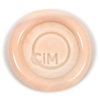
A creamy opaque tan, less reactive than the ivories, that makes an excellent neutral base color.
Click here to view
Ginger
Uniques
|
|
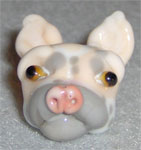
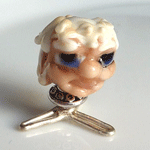
"Ginger is a nice soft peach which I have not found in any other color palettes. It works well used as a Caucasian skin tone that I like to use for my santa's and it was a perfect skin/fur color for use in this sculptural french bulldog." – Genea Crivello Click here for other interesting Ginger discoveries.
|
CiM Tester Feedback
-
Ginger is, in general, a non reactive color.
“This is what I love best about Ginger - it doesn't react very much with the reactive colors." – Chris Molter
“It is a great substitute for ivory when you do not want a reaction with other glass." – Janice Laster
“Dark colors seem to "sink" into Ginger, leaving very soft, ill-defined edges. If you like that it is great; on the other hand, if you want defined edges on dots and lines, it can be a problem.” – Tim Gottleber
-
Ginger is an excellent neutral base color.
“This color often looks like Butter Pecan. It’s a little bit warmer in tone and makes a great base color.” – Gail Witt
“I loved working with the Ginger and using it with reactive frits. It makes the most beautiful organic beads. It etches, presses well, marvers well, isn’t shocky, melts smooth, and is lovely to work with." – Janice Laster
“WOW! What a versatile color! I absolutely love working with Ginger. It is such a wonderful base or surface decoration. It ranges from a flesh tone to beige. It looks great with everything." – Stephanie Risberg
-
Some Messy Color testers described Ginger as “streaky,” but only if overworked.
“It is a little streaky but the color is so light it doesn’t show up too much.” – Gail Witt
“It is sometimes streaky. But that adds to its charm. Some beads had no streaks whatsoever while others had lots of streaks. I thought it might be the graphite marver, but only ½ the beads that I marvered had streaks.” – Stephanie Risberg
-
Ginger does not change when reduced.
“I did not notice any change in appearance when reduced.” – Stephanie Risberg
“There was no reaction with either reduction or oxidation.” – Tim Gottleber
-
Special thanks to Evil Glass, Teri Wathan, Jolene Wolfe, & Trudi Doherty for providing the photos in this section.
Join Trudi Doherty's FB group Lampwork Colour Resource Sharing Information for a catalogue of color study.
Claudia Eidenbenz’s "Vetrothek" (glass library) is a great resource for color comparisons.
See Kay Powell’s frit testing samples.
Browse Serena Thomas’ color gallery.
Check out Miriam Steger’s CiM color charts.
Consult Jolene Wolfe's glass testing resource page.
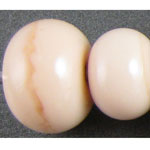
"Ginger is a pretty, soft peachy-pink opaque colour. It is fairly inert - it will fume and discolour with silver, but in a much milder way than other neutral colours like Ivory. Ginger doesn't change colour when you reduce it. You can see in the bead here that Ginger can be a bit streaky. In that bead, a lot of the colour migrated to the middle of the bead when I was melting it down." Read more at Melanie's blog. |
|
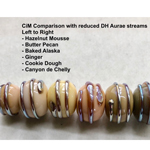
| CiM comparison with reduced DH Aurae streams. See more at Darlene's blog. |
| Ginger & Smurfy.
–
Jolene Wolfe
|
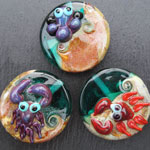
| “I love making these ocean critter beads, the sandy beach effect is really pretty I think. I make this look by wrapping Ginger with silver leaf and then vapourising it in the flame.” Read more at Kitzbitz Art Glass’ blog. |
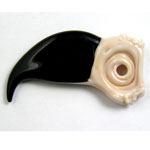
Bear claw made with Ginger & Tuxedo. "Ginger is much easier to use than Moretti ivory as it has more viscosity when hot."
– Robert Jennik
|
|
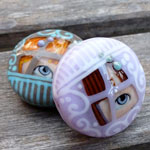
| "A color I like to use for skin." Check out Claudia's eye tutorial in her book Glass Bead Trip. |
"I used Ginger for the face, which got a lot darker with the longer working time than it did when I made test spacers – now I know how to get what I want out of it!" Read more at Heather's blog. |
|
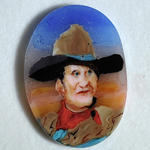
| "I did a class with Loren Stump and we were both thrilled with the results we got with Ginger. This John Wayne murrini was made by me at Stumpchuck Studios with Loren Stump." |
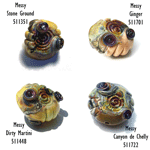
"I did a color study called 'Other than Ivory' using some Messy Colors in those wonderful earthy tones." Read more at Genea's blog. |
|
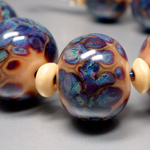
| Ginger as a base for DH Terranova silver infused frit. Read more at Darlene's blog. |
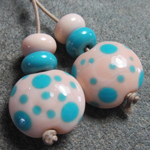
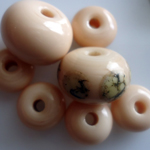
“I made these sweet and simple little spacer beads from CiM Ginger. One of the larger beads has dots of silvered ivory stringer too. The fine silver leaf used to create the organic patterns and striations in the Effetre ivory stringer have not fumed or reacted with the base of Ginger at all which tells me that it would be a great glass to use if you were looking for a light and neutral non reactive base glass for your bead design.” Read more at Kitzbitz’s blog. |
|
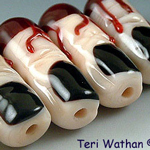
| “Ginger works great for skin tone, in my opinion. Ginger and Unique Butter Pecan are the only colors I use for my fingers.”
–
Teri Yount
|
"This is a Ginger base on the left and a Butter Pecan base on the right, with dots, Butter Pecan on the left and Ginger on the right. When hot - it is really difficult to tell them apart, but once melted, they are quite distinctive." Read more at DragonJools blog. |
|
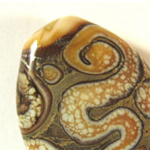
| "I rolled the Ginger in silver foil and did stringer work with Moretti Ivory. The silver goes to the center the more you heat. Cool effect! And the silver takes on a goldish tone."
–
Leslie Anne Bitgood
|
"Ginger is a nice soft peach which I have not found in any other color palettes. It works well used as a Caucasian skin tone that I like to use for my santa's and it was a perfect skin/fur color for use in this sculptural french bulldog."
– Genea Crivello
|
|
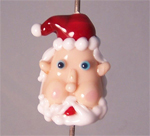
| “I like Ginger for faces. It takes a lot of abuse. If it is heated too much, a little darker shade of peach will emerge in streaks."
–
Dianna Trout
|